Design, Self Build, Sustainable Design
Explore: A Stunning Australian Treehouse
Tucked away among the trunks of ancient jarrahs in the bushlands of Western Australia is a timbered house that lives and breathes its natural surroundings.
After three hours driving south of Perth, Australia’s most westerly city, the red dust highway plunges through bushland of just about the deepest, darkest, most verdant kind the natural world has to offer.
This is the stunning coastal region of Margaret River, a haven for biodiversity where thickets of fast-growing hakea and bright red-flowering gum surround the majestic jarrah trees.
Centuries-old branches reach up 40 metres or more to meet the big, blue Western Australian sky.
Amongst the thick trunks and lush foliage 10 kilometres from the ocean is a fully timbered house that blends so seamlessly with its natural surroundings that it’s all but hidden – and that’s just how its owners like it.
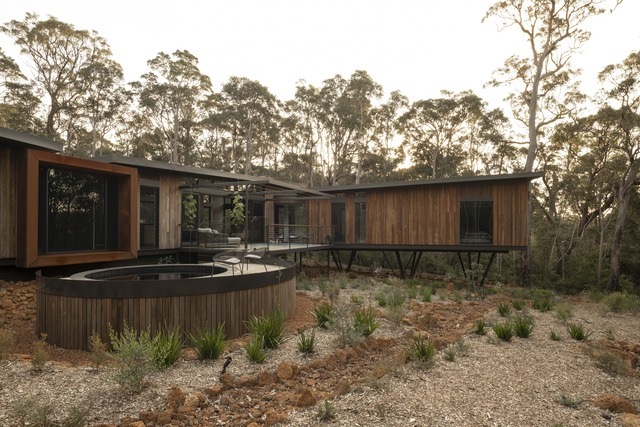
Image: Dion Robeson/A Design Features
A natural, rural environment
We were looking for a really natural, rural environment to build our own semi-permanent home,’ explains Glen, a project manager who with his husband Anthony, had recently returned to Perth after more than a decade living in Sydney.
‘We had a dream of living sustainably, growing and eating our own produce and being able to entertain our friends and family there too,’ adds Anthony.
‘In Margaret River, we found a steep, wooded block of land that had all we could have wished for in terms of natural surroundings.
‘It’s also not far from the beach and the town, not to mention the abundant market gardens and wineries the region is famous for.
’But when it came to the building, Glen and Anthony’s project was not without its complexities.’
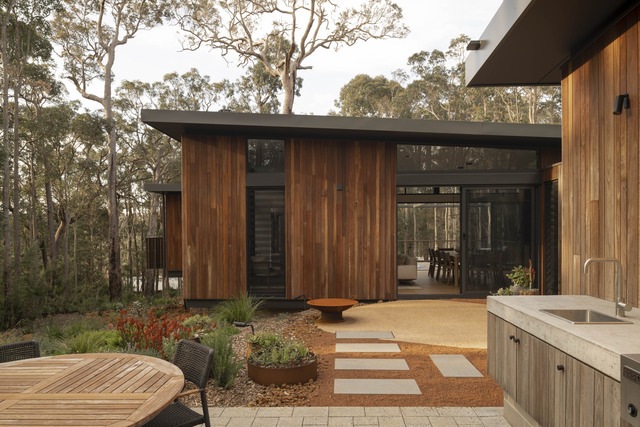
Image: Dion Robeson/A Design Features
Challenges ahead
Designing a relaxing hideaway incorporating all the features the couple and their guests could want for a comfortable and simple life among the trees was just one aspect; a far greater challenge was to ensure that it would work in harmony with the local nature.
‘Because we’re in such an environmentally important area, on a piece of land that is not at all flat, with no sewage and power constraints, the council had a lot of requirements,’ remembers Anthony.
‘We had a really good dialogue with our architect, Suzanne Hunt, who produced a dozen versions of the plans before hitting on a design that delivered a slightly smaller footprint than we had originally envisaged, but catered to the environmental needs of the site, all within our fairly modest budget.’
All that stood between the drawing board and the arrival of the builders was planning approval, and this took more than a year to be granted.As part of the process, rangers camped on Glen and Anthony’s patch of bushland for three nights to ensure that the existing habitat was not a breeding ground for endangered carnaby black cockatoos or ring tail possums.
The council also assessed the site for its vulnerability to bushfires, a real hazard in this heavily wooded region, and a great deal of work had to be done to clear vegetation from the site.
The risk of fire contributed to Glen and Anthony’s decision to choose naturally fire-resistant spotted gum timber cladding and the result, after 18 months of building work, is much more treehouse than holiday house.
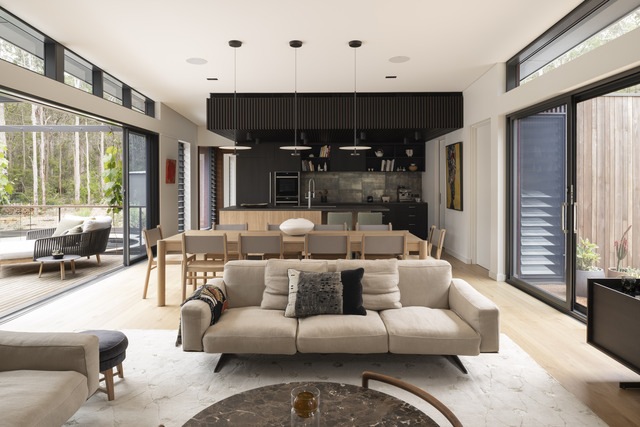
Image: Dion Robeson/A Design Features
The iconic Treehouse
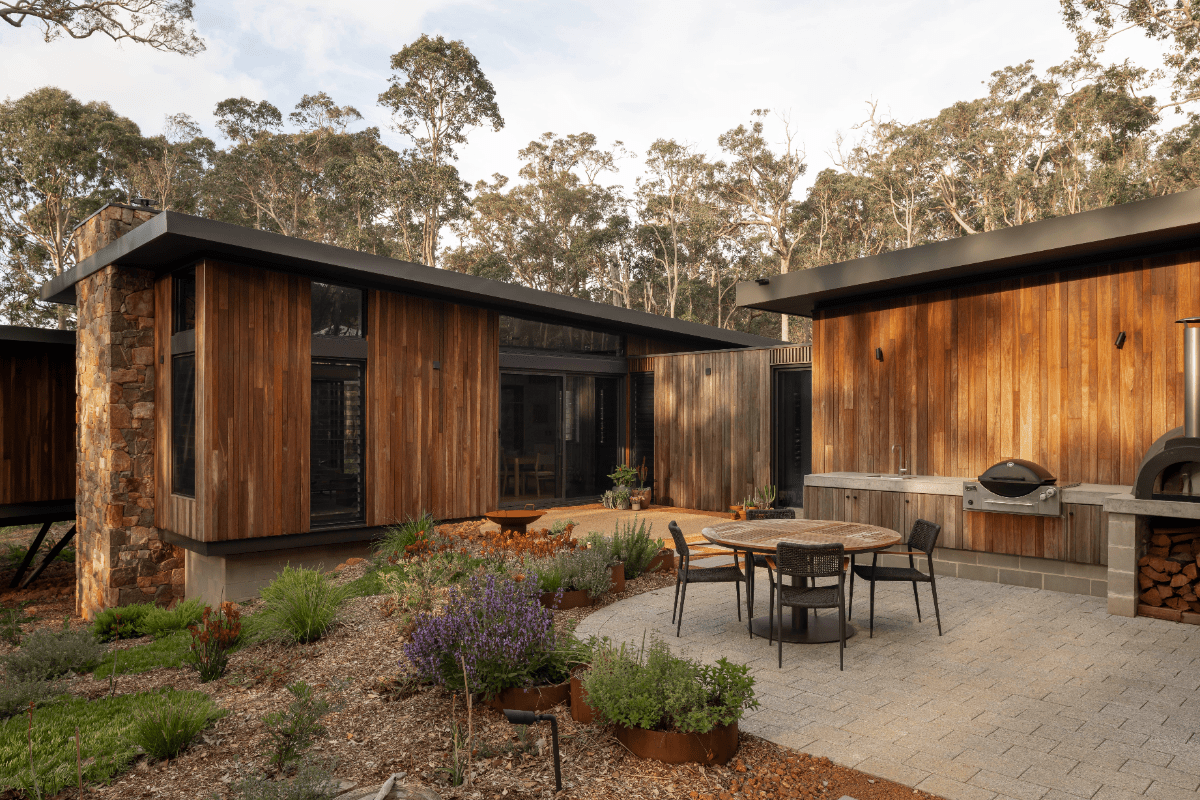
A single-level home nestled amongst the natural vegetation, it’s rendered almost invisible thanks to the exterior timber panels, arranged in an uneven pattern that echoes the varying breadths of the giant tree trunks all around.
Cleverly and simply designed, it consists of a central living hub and two bedroom wings raised up so that they reach out into the foliage on either side and above the bushland.
Right in the middle of the house is a kitchen with a generous island for relaxed cooking and entertaining, and a large and convivial dining table.
The lounge has a fireplace made from Margaret River stone and tall, narrow aluminium-framed windows to bring in views of the stunning natural landscape to the north.
Glen and Anthony can look out to the north and the east from the main bedroom wing, which has a cosy snug as well as an ensuite bathroom.
A real luxury is the spectacular outdoor shower, installed on a floating deck up high in the tree canopy. Guests are well catered for too.
The second wing has two bedrooms and a bathroom and can be closed off from the rest of the accommodation by large sliding doors for privacy, and also for energy efficiency when not being used.
‘The orientation of the building means that the sea breeze comes straight through the house and is sucked into the wings,’ explains Glen.
‘This makes it pleasantly cool to sit inside together.’
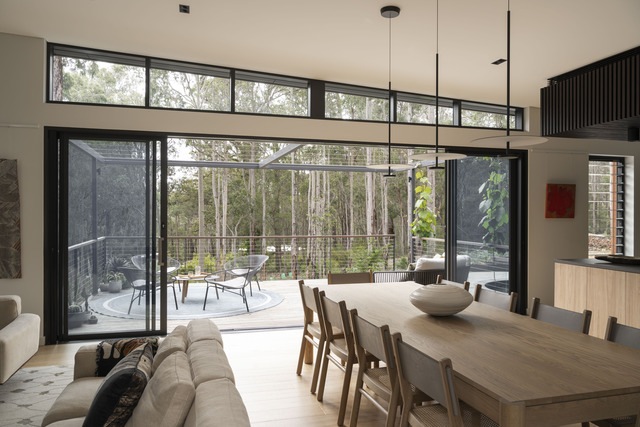
Image: Dion Robeson/A Design Features
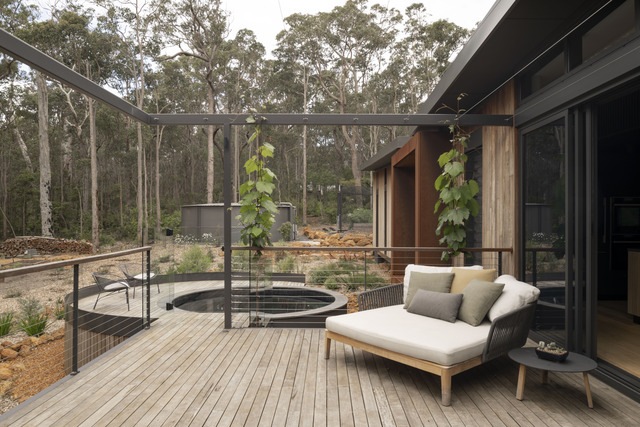
Image: Dion Robeson/A Design Features
‘The outdoor environment is a real draw for our guests, just as it is for us,’ explains Anthony.
‘We really benefit from the surrounding vegetation and the southerly breezes and can spend time outside here in the warmer months, which can be a challenge in more urban areas.’
Both keen gardeners, Glen and Anthony have enjoyed planting more than 2,000 local native plants to revegetate the site, and they cultivate fruit and vegetables too.
‘Farmers produce a lot of varieties very easily in this region, so you can buy local avocados, for example,’ says Glen.
‘But we love using our garden to grow raspberries and other vegetables that are more difficult to find.’
The flow of water on the sloping site, not just to suit the fruit and veggies but also to service the treehouse, had been a concern from the outset.
A solution was found by Glen and Anthony’s landscape designer, Damien Pericles, who created new, naturally-inspired rock creeks to channel water around the house.
The necessary 90,000-litre water tank, an aerobic treatment unit and 20kW of solar photovoltaic panels with batteries have been accommodated too.
‘We really can live off-grid here,’ smiles Anthony. ‘We do too, in summer and autumn.’In fact, the pair are spending far more time in Margaret River than they had expected.
‘As soon as the treehouse was completed, we felt completely at home in the bushland, and our stays got gradually longer and longer,’ says Glen.
‘We’re living here more or less all the time now and, as we get older, we’re sure this is the natural place for us to be.’
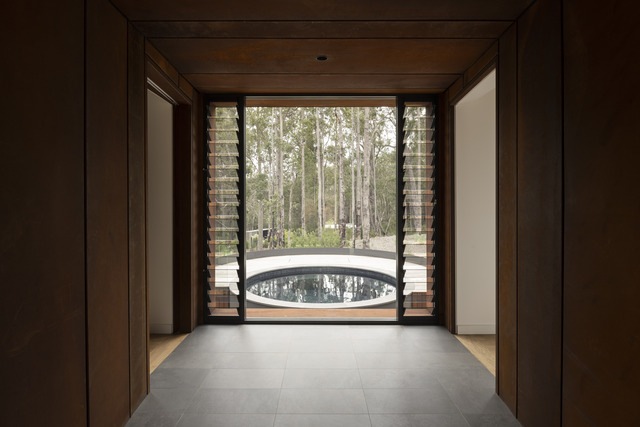
Image: Dion Robeson/A Design Features
READ MORE: