To the rescue of a fairytale tower in Thorpeness
When architect Tom Leahy took on an eccentric former water tower in a magical Suffolk village he got more than he bargained for, but after a lot of work and the application of an unusual restoration technique, he has ended up with a wonderful one-of-a-kind place by the sea
Thorpeness is a rather special place: a quaint village on the beautiful Suffolk coast, built as a private Edwardian holiday village by an eccentric local landowner.
Now one of the most striking buildings in this characterful place has been given a tasteful glow-up – and you’re invited inside to take a look…
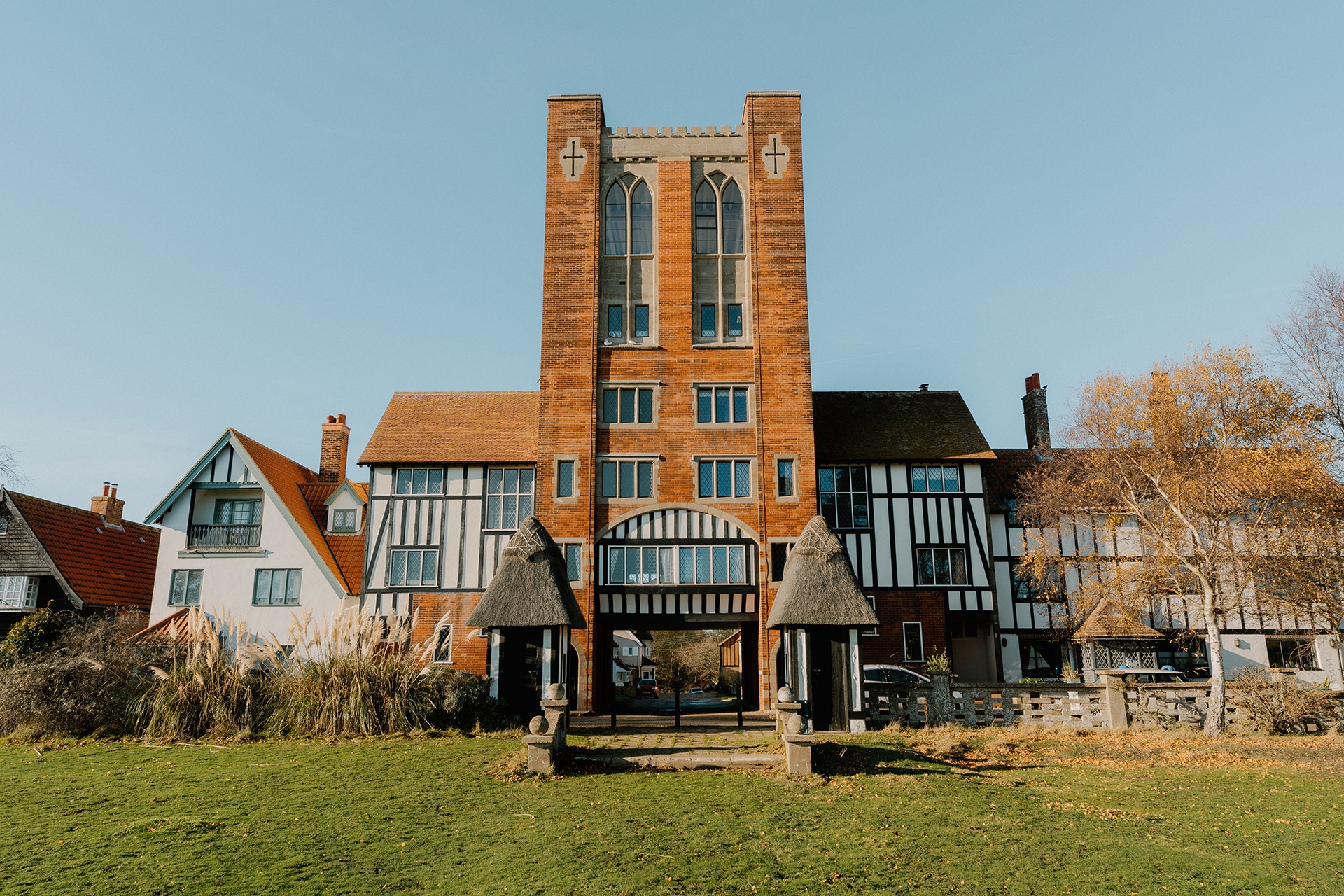
The water tower was designed to look like a mediaeval building Image credit: Daniel Casson
History of a holiday village
It was a barrister and playwright called Glencairn Stuart Ogilvie, whose family had made money in the Victorian railway boom, who bought up the hamlet of Thorpe, north of Aldeburgh, in the first decade of the 20th century with the vision of building an exclusive resort for his family and friends.
Working with architects William Gilmour Wilson and Frederick Forbes Glennie, from 1910 he employed mock Tudor and Jacobethan styles to create an idealised vision of pre-industrial England – and build a village that looked as though it had evolved organically over centuries.
Buildings were intentionally picturesque, irregular, and storybook-like but there were plenty of mod cons, too. Holidaymakers could enjoy a country club and the boating lake, known as the Meare.
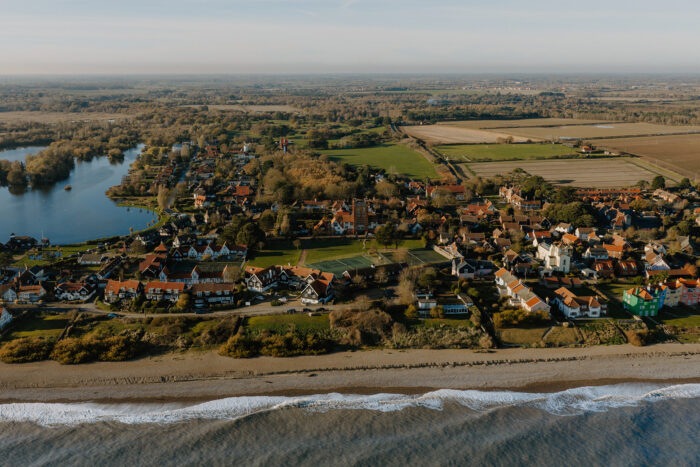
With its meare, picturesque buildings and shingle beach, Thorpeness is as appealing a holiday destination today as it was in its heyday Image credit: Daniel Casson
Magical place
Whimsical touches that added to the magic of the place included a water tower disguised as a “house in the clouds” and features on the Meare named after places in the story of Peter Pan, because author JM Barrie was a family friend.
The village is still a special place today.
The picturesque buildings remain, and new generations of residents and tourists alike still enjoy boating on the Meare, playing tennis in the village courts, and having fun on the shingle beach.
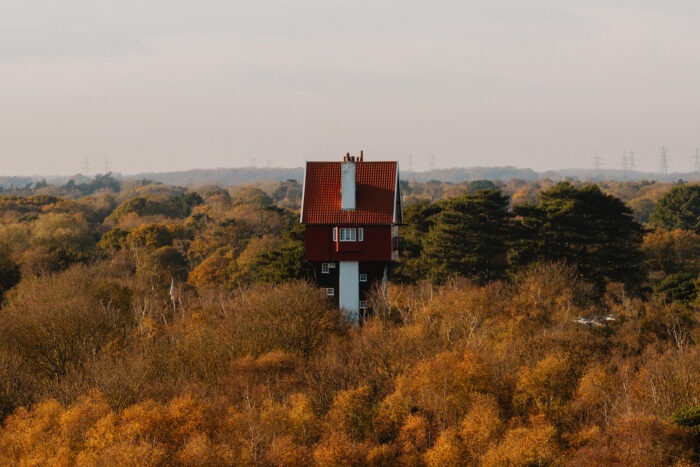
The House in the Clouds is Thorpeness’s other, more well known, water tower. Image credit: Daniel Casson
Architect to the rescue
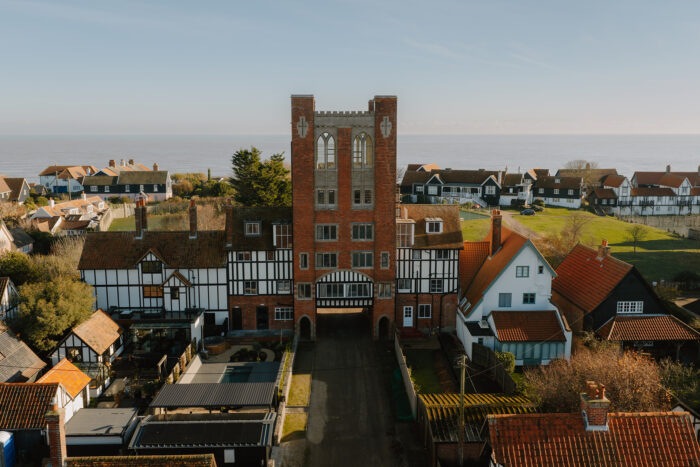
Architect Tom Leahy has just finished turning the village’s other water tower – West Bar, designed to resemble a mediaeval tower with castellations and gothic-style detailing – into a luxury holiday home for some of today’s holidaymakers to enjoy.
The five-storey, grade II-listed tower sitting in a row of half-timbered cottages, over a large archway, lies at the heart of the quirky village.
Originally, it contained two three-storey holiday cottages with a plant room above and big water tank at the top, which served the homes in that part of the village.
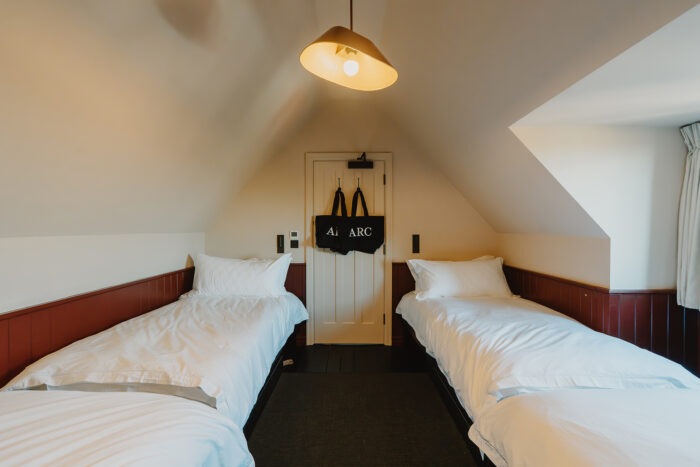
Tom has managed to fit eight bedrooms into the tower Image credit: Daniel Casson
Water tower conversion
It was decommissioned as a water tower in the 1980s, and sold off at auction by the water company in 2007.
In 2012 permission was granted to convert it into a house, and the then owner removed the plumbing and equipment from the plant room and the water tank from the tank room.
He added windows to the tank room and converted it into a large living space with wonderful views over the sea.
As a keen antique collector, he used the spacious new room at the top of the tower to hold parties and display his collections.
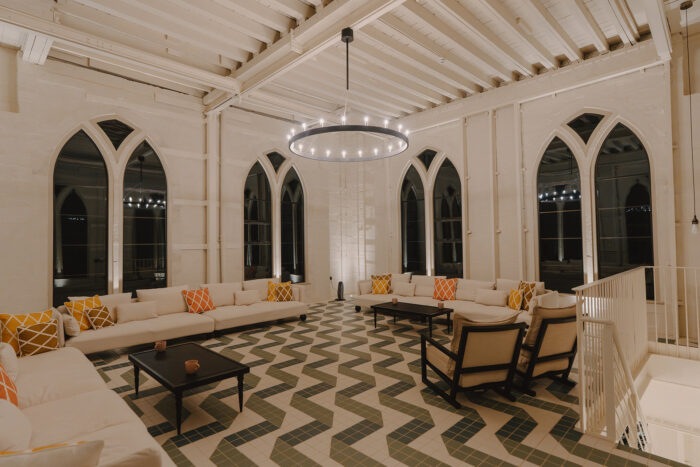
The former water tank has made a wonderful living space at the top of the tower Image credit: Daniel Casson
Structural issues
After he died a several years later, his family put the tower on the market, but finding a seller proved difficult because, by now, there were serious structural issues with the building.
The tower is mainly clad in brick but concrete was also used in the build, and this was the source of the problem.
Tom explains, “When the tower was built in the early twentieth century, concrete was only just starting to be widely used, and they hadn’t really perfected the techniques.
“Lots of the buildings in Thorpeness, including ours, were made of concrete blocks that they made right there on the beach.
They mixed cement with shingle, dried the blocks in the sun, and then started making these buildings out of them.
“The water tower is constructed with a steel frame sitting directly within some of this early concrete.
“In modern buildings you always leave a gap between the steel and the concrete to allow the steel to expand if it corrodes.
“But here there is no such gap – and that creates problems.
“The porous cement lets water into the building fabric, which rusts the steel.
“As it rusts, the metal expands, cracking the cement, allowing even more water in.”
And so a vicious cycle of decline begins for an affected building.
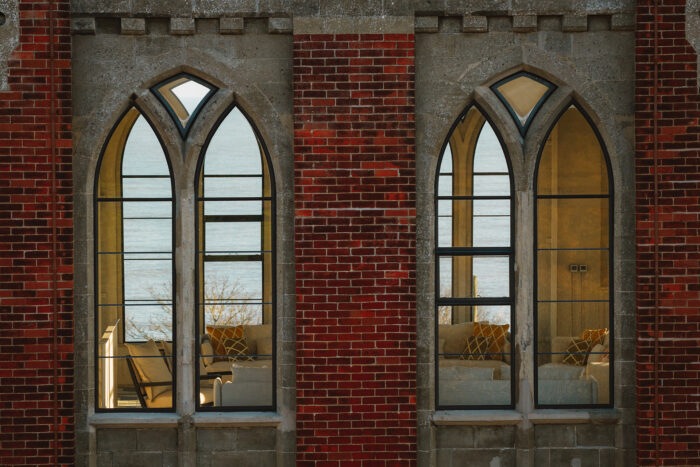
The early cement in the building created structural flaws that needed to be fixed Image credit: Daniel Casson
Regent Street disease
This problem is known as Regent Street disease because it affects the buildings of London’s Regent Street, which was rebuild between the end of the 19th century and 1930 – the same era that saw the birth of Thorpeness – with this same structural flaw.
Because of these problems, Tom was able to buy the Thorpeness tower cheaper than its original list price.
He calculated that the reduced price would leave him with enough budget to make the necessary repairs and fully renovate the property, for there are solutions to Regent Street disease.
Tom explains that he had two options: option one was to remove and replace the rusted steel, which would have cost hundreds of thousands and involved pretty much dismantling the whole structure.
Luckily there was a second option.
Cathodic protection
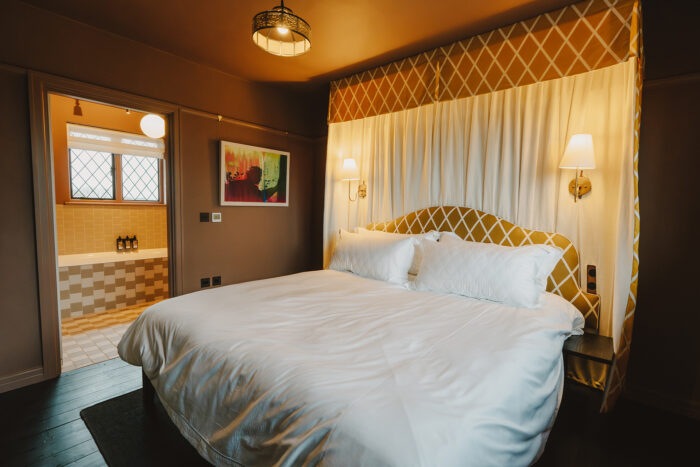
There’s a quirky period feel to the interiors that matches the building’s historic exterior Image credit: Daniel Casson
This was a procedure called cathodic protection; which is a way of stopping metal from rusting by interrupting the natural chemical process that causes corrosion in the first place.
When metal is exposed to water and air, parts of its surface begin to lose tiny electrical charges (electrons), allowing metal atoms to break away and form rust.
Cathodic protection works by continuously feeding “extra” electrons into the structural metal from an external source, so that the metal atoms don’t lose any electrons, stay stable – and don’t corrode.
As long as the metal is “kept supplied” with electrons, it can no longer break down or dissolve, and corrosion effectively stops.
This is achieved either by attaching a second, more easily corroded metal that “sacrifices itself” instead of the primary material, or by running a small electrical current through the structure being protected.
Cathodic protection is widely used wherever metal structures are exposed to moisture – on ships, pipelines, bridges and coastal buildings.
In this case, a permanent current was run through the steel structure.
“You actually ‘sew’ a copper ribbon into the brickwork and run a negative charge through it,” Tom explains.
“And that stops the steel from taking on water particles. So it doesn’t rust.”
This was not a cheap fix. Tom recalls, “It cost £100,000, plus the scaffolding needed to install it was £130,000.
“Then the work to the brickwork to allow it to be installed was another £150,000.
“All in all, it cost about £400,000 for the solution.”
Architectural retreats
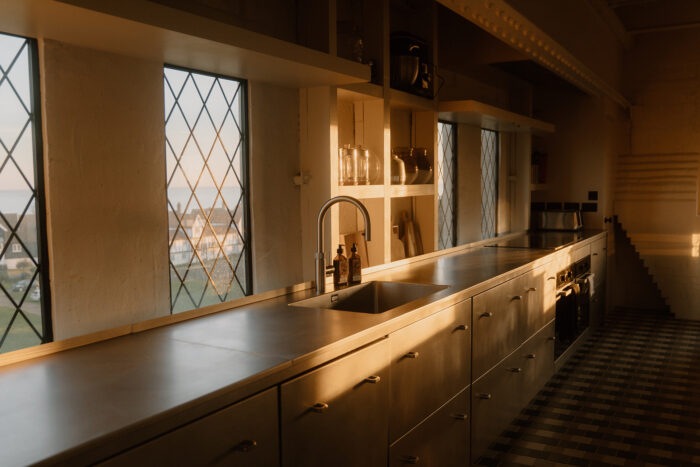
The sleek modern kitchen in the old plant room is big enough to cater for large groups Image credit: Daniel Casson
Luckily Tom is not daunted by such major works.
He is a professional architect who, as well as practising building design, has set up a company to develop and run large, high-end holiday lets.
Under the brand name ARC, he now has a small portfolio of beautiful buildings, which have all been tastefully refurbished ready to let out to large groups of friends and families for celebrations and holidays.
At present Tom has luxury holiday properties in Padstow, the Cotswolds, the Peak District and Wells -next-the-Sea, as well as Thorpeness.
Each is design led, for exclusive use by individual groups or families, with large communal areas, and serviced by a house manager.
He has more in the pipeline.
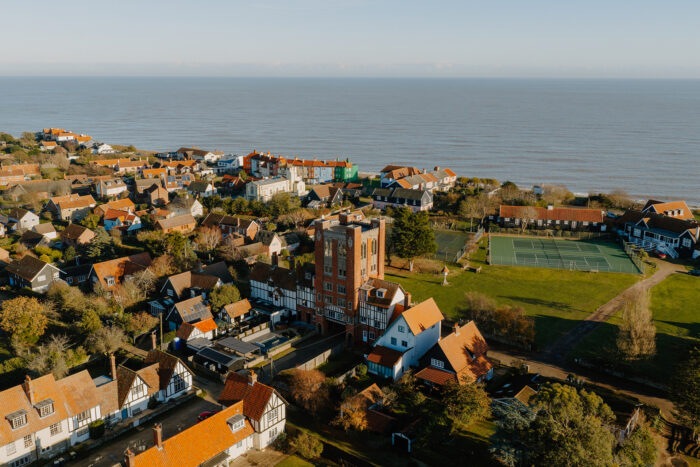
Thorpeness has its original sports facilities for holidaymakers – tennis courts and a golf club Image credit: Daniel Casson
Unconventional reinforcements
At Thorpeness his team uncovered all kind of unconventional, rather Heath Robinson reinforcements in the building’s experimental, early-era concrete construction: for example, old golf clubs and curtain poles that had been used to strengthen window and door lintels.
These crumbling lintels also had to be removed and replaced.
And, while the expensive scaffolding was in place, Tom to the opportunity to get the windows replaced, too.
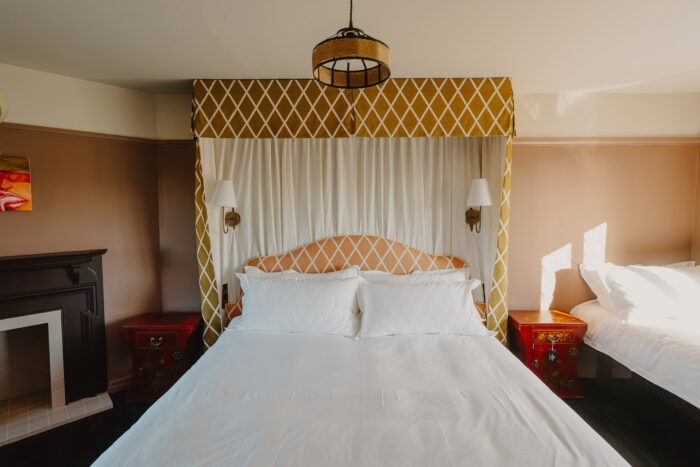
The property now sleeps 20 Image credit: Daniel Casson
Reconfiguring the interior
Once the building was structurally sound, Tom set about reconfiguring the interior.
In line with the other properties in his portfolio, he wanted to make the tower able to accommodate large groups in comfort.
He decided to retain the top tank room as the property’s main living space.
“We kept the historic metal staircase up to the top floor, he explains, “and retained the bottom of the water tank as the floor of the lounge.”
Tom put the large kitchen on the floor below, then, using all his design skills, he fitted eight bedrooms into the three floors below.
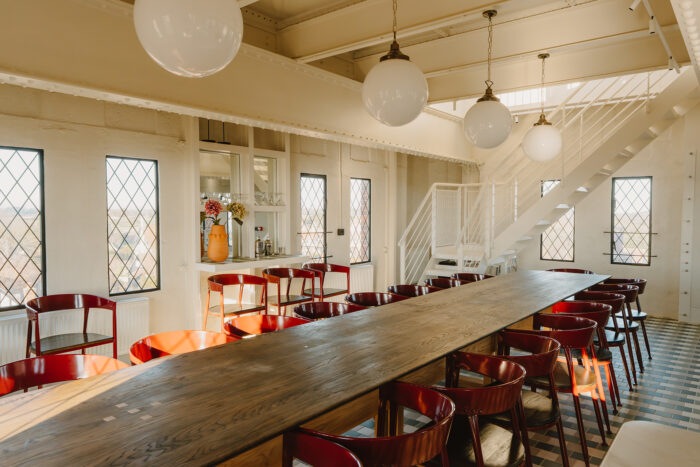
There’s a huge dining table long enough to seat everyone Image credit: Daniel Casson
Hidden en suites
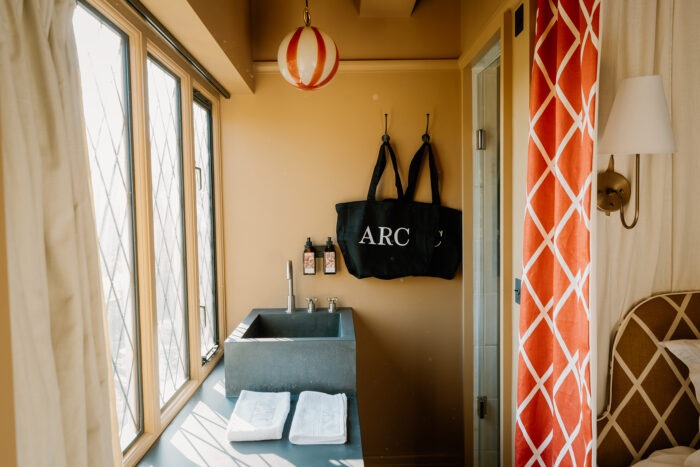
Tom has squeezed ensuites in behind the headboards Image credit: Daniel Casson
Most of the bedrooms are big enough to contain a king-sized bed and ensuite.
The ensuites are cleverly tucked behind room dividers-cum-bedheads – see the neat design in the plan below.
Clever siting of sinks on windowsills maximises the use of space, and means the sinks can be a generous size.
All this smart use of space means the house now sleeps 20 comfortably.
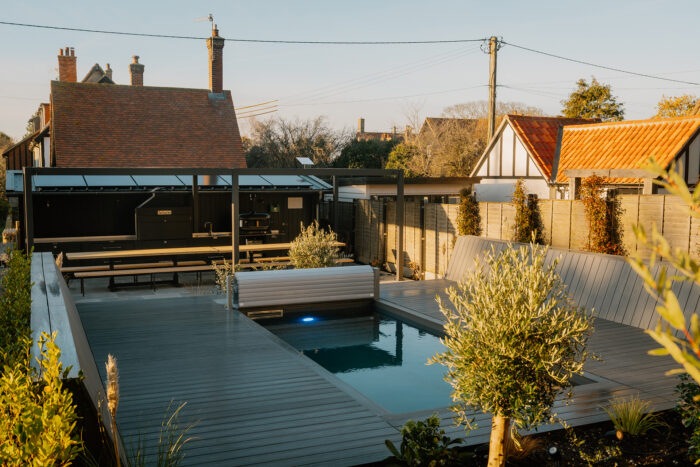
Outside there is a small pool, hot tub and dining area under a canopy Image credit: Daniel Casson
Outdoor facilities
Outside, there is an alfresco kitchen complete with pizza oven, Braai South African-style barbeque, and long dining table beneath a pergola.
There is even a small heated pool and hot tub.
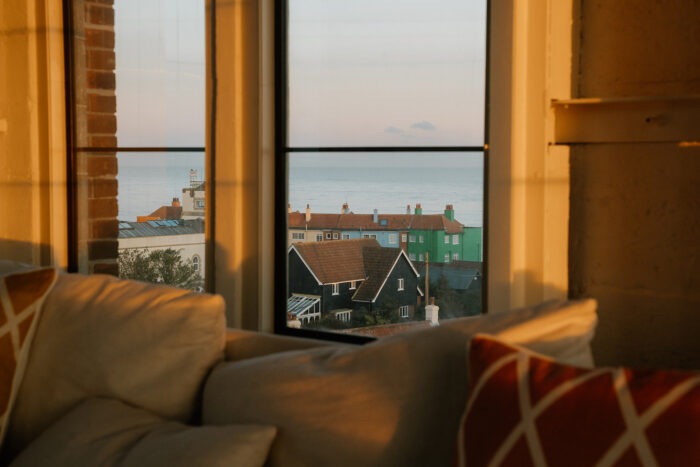
Where better to watch the sun set over the sea, than from the room at the top of the tower? Image credit: Daniel Casson
Room with sea views
The highlight of the property remains the extraordinary top-floor living room that fills the entire top floor of the tower and has wonderful 360-degree views out over the village, tennis courts that were part of the original holiday village’s country club, and beyond to the sea and Suffolk Heritage Coast.
This is surely a makeover that the original founder of Thorpeness would have approved of, involving as it has the loving restoration of one of his charming, characterful buildings, and the provision of luxurious modern accommodation that enables today’s holidaymakers to continue to enjoy this wonderful place in style.
You can find out more about the property here
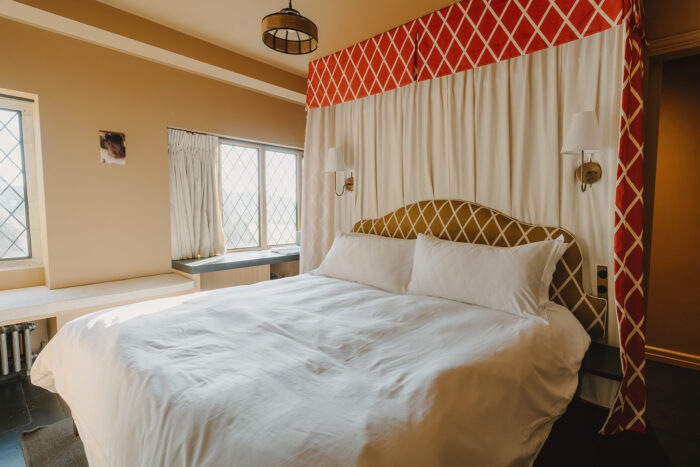
Thorpeness was always intended to be a home away from home Image credit: Daniel Casson