Agricultural avant garde: Housestead is the ultimate contemporary country home
This extraordinary family home, in a beautiful corner of Suffolk, creatively reinterprets the traditional farmstead to create a stunning sustainable home.
We take a sneak peek at a fabulous project in Suffolk…
Architecture dynasties
Amir Sanei and Abigail Hopkins run a successful architecture practice, Sanei + Hopkins, with a track record of thoughtful and interesting sustainable contemporary builds.
Both also come from families of celebrated architects. Abigail is the daughter of Sir Michael and Lady Patty Hopkins, high-profile designers of wonderful buildings that blend hi tech architecture with craft skills and a sensitivity to context.
Meanwhile, Amir’s father was a professor of architecture at the University of Tehran, and his grandfather Ostad Ali Mohammad Sanei was also a revered architect in Iran, where he designed buildings that blended traditional Persian architecture with Western styles.
He worked for four Shahs on projects including palace improvements earning the honorific title Memar-Bashi or “knight of architecture”.
Even the name “Sanei”, adopted by Amir’s grandfather, means “builder of beautiful structures” in Farsi.
Such highly talented parents – the Hopkins’ famous projects included the Mount Stand at Lords Cricket Ground, the David Mellor cutlery company’s offices and showroom, Glyndebourne Opera House, Manchester City Art Gallery, Portcullis House and Westminster underground station, some of which Amir worked on – were obviously a hard act to follow, but this wonderful, cerebral yet light-hearted building is good enough to hold its own in the most distinguished of architectural company.
Countryside get-togethers
Peter Landers Photography
Peter Landers Photography
Housestead sits in the grounds of an estate near Aldeburgh that was bought by Abigail’s parents in 1995.
So this beautiful part of the world has been a much-loved part of her life for a long time, and it was only natural that, when she had a family of her own, she would want them to spend time there.
When their children were young, the couple had the use of a cottage on the estate and loved spending time there, enjoying extended family gatherings.
Abigail recalls, “We were close to my parents’ house and my other siblings also each had a base on the estate.
“And the kids would wander between the houses. It was a very free environment for them. We were very lucky.”
She makes the family gatherings in the grounds of her parents’ house sound idyllic.
There was much outdoor living with meals eaten outside even when the weather was less than balmy.
Indoor-outdoor thresholds
Peter Landers Photography
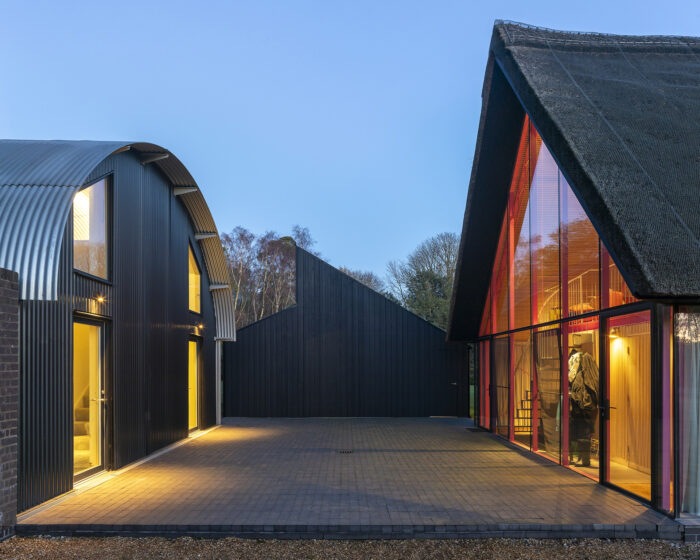
This indoor-outdoor lifestyle is a key inspiration behind the new house, which consists of four separate blocks – for living, sleeping, working and a utility block – with spaces between that must be navigated in all weathers.
These spaces act as a threshold between life indoors and the wider landscape, bringing in light, air, scent, and weather – and inviting the occupants to experience nature as part of their daily routine.
The idea is that these interludes in the fresh air provide a pause between functions, and a chance to re-engage with the body and the senses.
Movement between blocks also encourages physical activity and engagement with the landscape, echoing the healthy rhythms of life on a traditional farmstead.
The couple’s original cottage was small, so, as architects with a growing family, they decided to replace it with a larger family home that would also have room for Amir’s parents to stay.
Abigail explains that her parents gave them another derelict cottage on the estate that could have been expanded, and their original plan was to do that before they realised it was never going to fit them all in: “Even with a big extension on it, that was never going to be big enough to make a comfortable family home.
So, reluctantly, as it felt like there was no other option, we decided we would demolish it and build a replacement. And we designed Housestead thinking that is what would happen.
“But when we started the planning process, which was a long one – about three years all in all – the planners felt (as we had) that the house we wanted to demolish had local heritage value.
“It was one of three lodges on the estate that have a relationship and use the same architectural language.”
Section 80e house
Peter Landers Photography
Luckily, the planners could also see the enormous value in the new building that Amir and Abigail had designed.
So they encouraged the couple to apply for permission under paragraph 55 of the National Planning Policy Framework NPPR (in the latest version now paragraph 80) a rule that allows for the construction of a new isolated home in the countryside if the design is of such exceptional quality, that it:
- “is truly outstanding, reflecting the highest standards in architecture; and
- would significantly enhance its immediate setting and be sensitive to the defining characteristics of the local area.”
Housestead surely meets these criteria, and so permission was given for what is known as a “paragraph 80e house”.
Abigail explains, “By shifting the new building just a little bit, we were able to keep the existing cottage. We built a little extension onto it, and it’s now rented out.”
Heathland
Peter Landers Photography
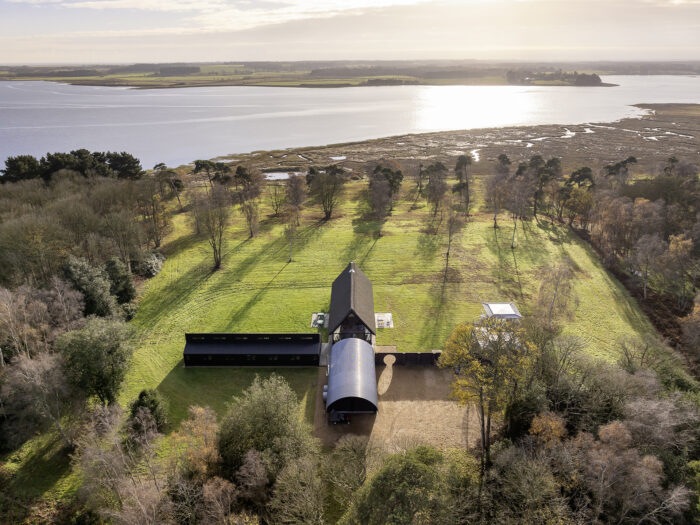
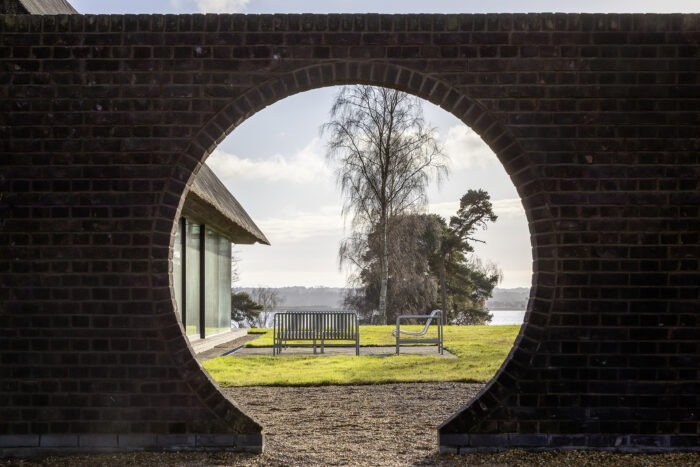
The site of the new house is stunning, on heathland overlooking the River Alde within the Suffolk and Essex Coast and Heaths Area of Outstanding Natural Beauty.
Abigail says, “It’s beautiful heathland with a mix of oaks and Scots pines that are very tall, and have been shaped by the wind, because it’s a very windy site.
“They have a very sculptural look. Our house sits in its landscape rather than occupying it – we just wanted to make the house sit very naturally in this very special natural landscape.”
In the design of their new home, they took inspiration from the layered histories of the farms on the estate, with their accumulated collections of functional buildings in both traditional and modern, quasi-industrial styles.
Farms are as much about utilitarian silos and sheds as they are about quaint thatched barns, and Homestead successfully captures the full range of these aesthetics in a distilled, elemental way.
Amir explains, “This estate has a hierarchy of buildings on it, with the main house in the middle, and then cottages that occupy an outer orbit.
“We are very much on the outskirts of the estate and buildings on the periphery of the original estate – before it was broken up and lots of it was sold – were farmsteads, so we took our cue from those.”
Agricultural inspiration
The building does indeed capture the essence of farm, without looking like one in any simplistic way.
Amir continues, “When we looked at farms there was always a cluster of buildings, that all have different functions, and different forms, and sometimes different materials.
So, we looked at how we could form a house using those ideas.
One difference though is farmsteads are inward looking, but we came up with a very simple cruciform plan, which is outward looking. In fact, you get to look in eight directions, rather than just one or two.”
So, the house is a cross shape which maximises views and outdoor space; the opposite of the inward-looking traditional farmstead clustered around a fold yard or stack yard.
Thatched living block
Peter Landers Photography
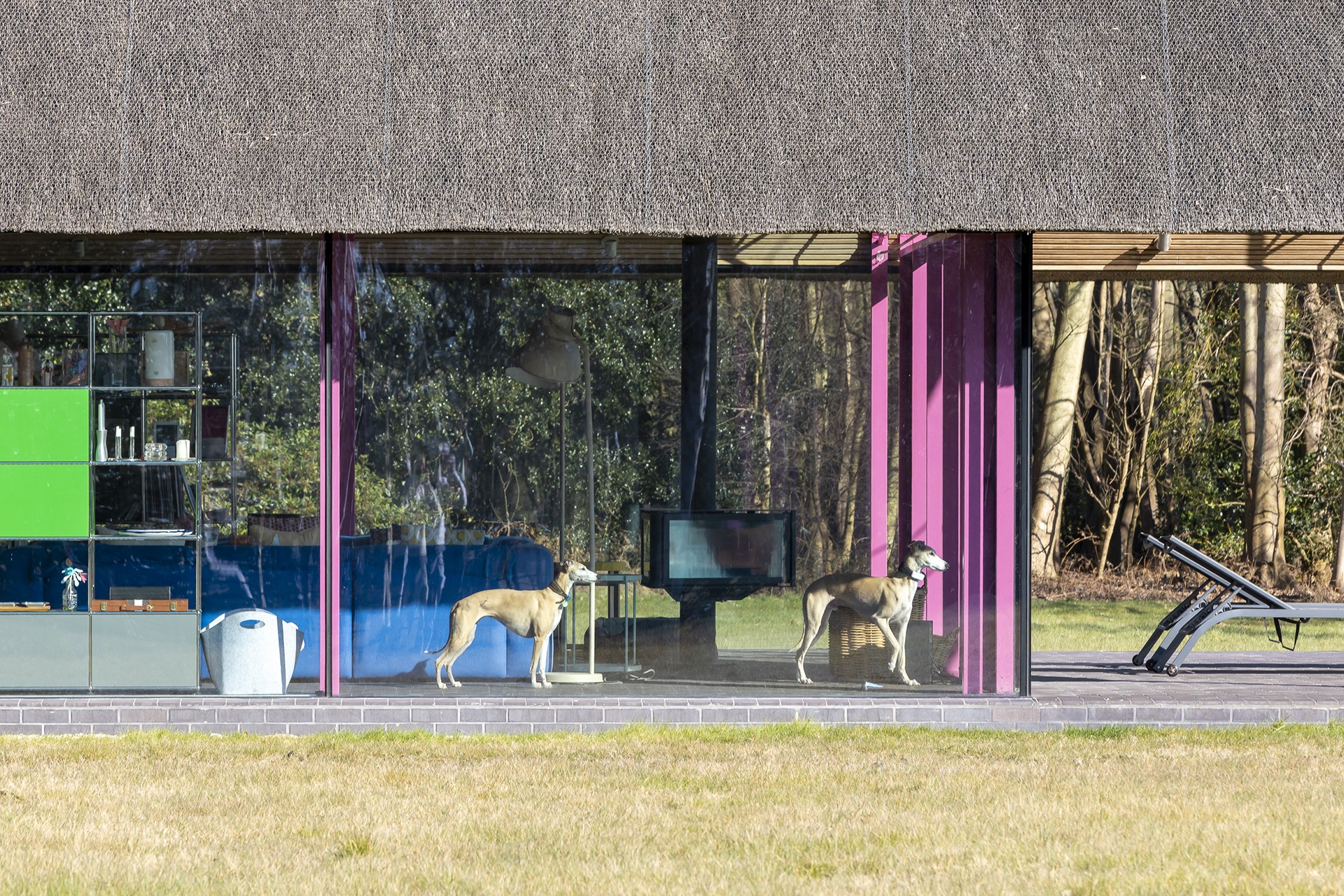
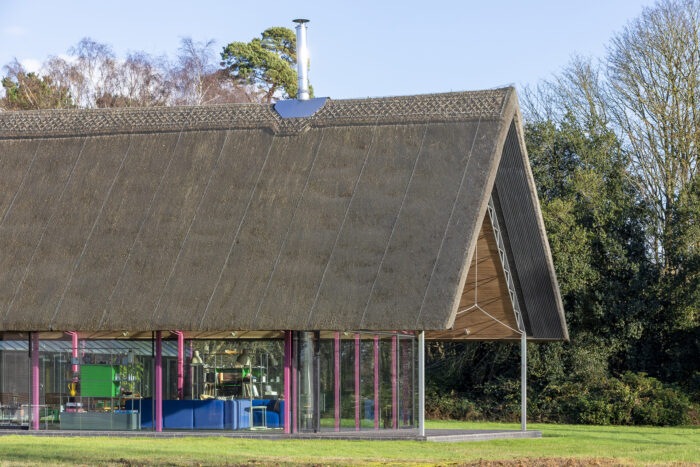
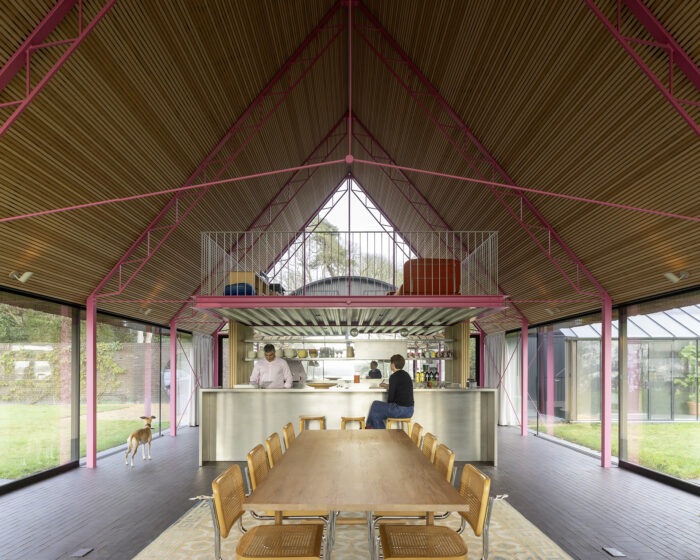
In the main living block a steel frame painted Suffolk pink (the colour of all those pretty, half-timbered cottages in the local area) and glass walls – hi tech elements the Hopkins senior would be proud of – are topped with a wonderfully incongruous deep thatched roof that almost appears to float above the ground.
The mix of old and new is an unexpected visual treat.
The room contains a large dining area with two long dining tables, seating area, plus an open-plan kitchen with small snug sitting on top of it up in the roof.
Amir explains, “The thatched roof takes the form of the most basic shelter in the countryside; that very rudimentary form of shelter common to pretty much every country in the world.
“Tropical to Nordic countries: all would have had a very similar type form.
“The walls are glass because the views are amazing and it feels like you are part of nature, almost as if you are outside.
“If the climate here were warmer, we wouldd just have some screens and no glass.
“There are a lot of Suffolk themes in it too – the nest above the kitchen, the hearts, the thatch, and the pink of the columns, a modern Suffolk pink.
“People wonder why is it long and thin and orientated north-south rather than east-west and facing the view.
“Well, the view is actually all around us – to our east and west and south – and the sun tracks all the way around.
“Having the glass on both sides means you can get the sun all the way around – and you get a morning terrace, an evening terrace and a midday terrace. So it’s actually a lot better.”
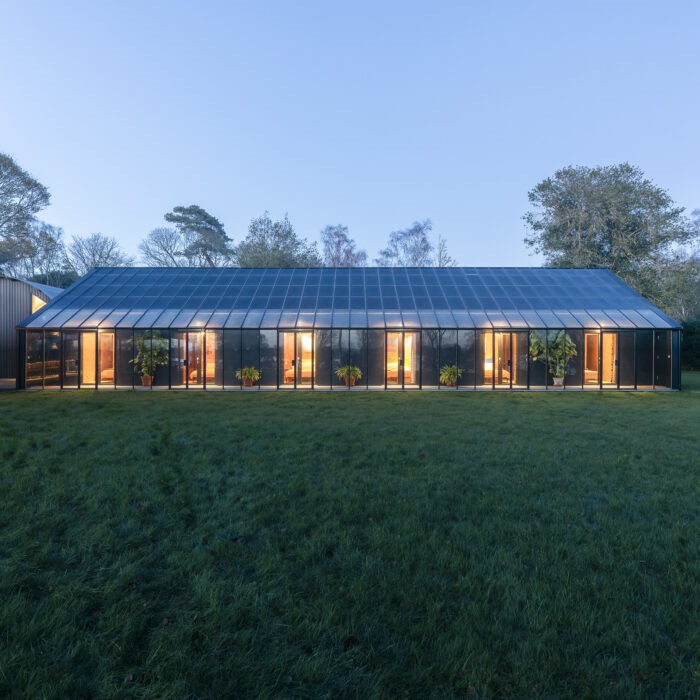
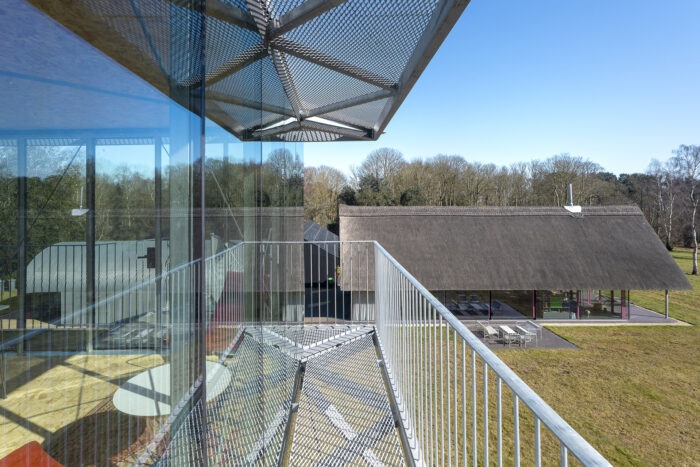
He draws attention to other design cues taken from the local area; “We’ve got a greenhouse (the sleeping block), a barn, and then the working block is like a pillbox.
“Pillboxes are another very Suffolk thing. There’s one on the estate near the riverfront and some gun platforms from Dad’s Army days.
“The study above the working block is akin to a watchtower, another a Suffolk thing.”
Peter Landers Photography
The working block is a square brick-faced block, with a square study/viewing tower above it supported on four steel legs and reached up an outdoor spiral staircase.
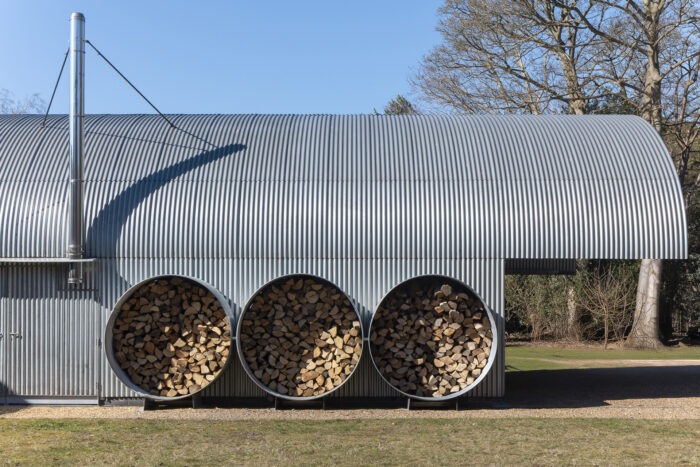
The third building, the utility building is very simple and functional, with something of the pig arc or Nissen hut about it – those prefabricated semi-cylindrical corrugated-steel buildings designed for speed of erection in war time situations.
Widely used in World War Two, many were subsequently repurposed after the wall as farm buildings, village halls and workshops.
The arched silver structure at Housestead holds the plant room, garage, biomass store – and, late addition upstairs, a teen hang-out and gaming room, for the children who have grown up considerably over the years the project has been in development.
Industrial aesthetic
Peter Landers Photography
Amir reflects, “I love the industrial aesthetic, whether it’s agricultural industrial or manufacturing, there’s just a very nice honesty about the forms and the materials.
“Not necessarily aesthetically beautiful, but there’s a rigour and a simplicity and an economy in material, function, size. Very much like a farmer – very matter of fact.”
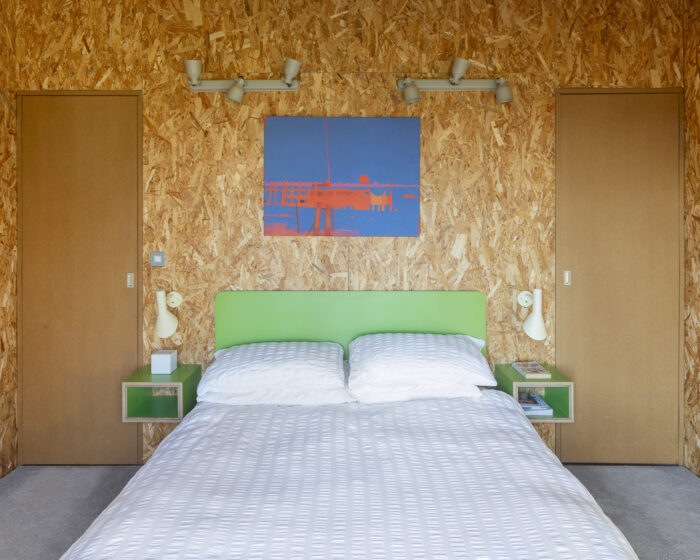
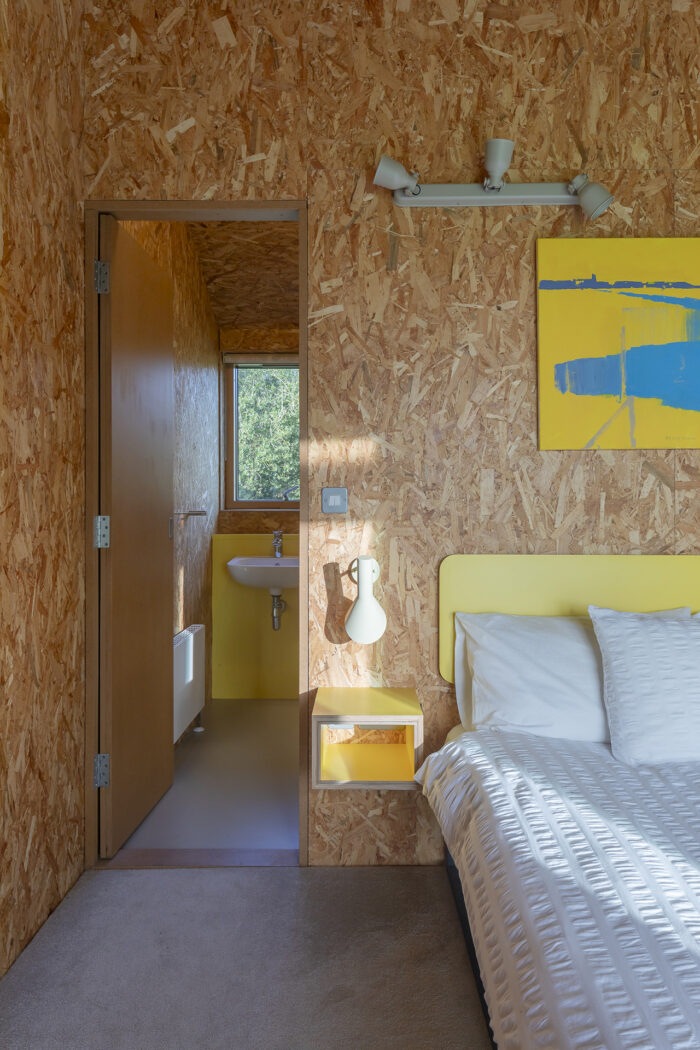
The timber bedroom block contains a row of six identical, quite utilitarian bedrooms, fitted out in OSB, each with its own primary-coloured detailing.
Inside there’s almost a stable vibe, outside the block resembles nothing so much as a greenhouse, and it is appropriately full of plants, while the roof houses the project’s photovoltaics.
The idea is the bedrooms will expand to form separate, self-contained living units, each with its own bathroom and kitchenette, when the children are older and want their own living spaces.
Peter Landers Photography
Sustainability
Abigail’s parents were pioneers of sustainable architecture and she and Amir share that passion.
The sustainability of Housestead is one of things they are most proud of. Amir reflects, “Everything we did was very much dictated by what was possible locally.
“Our groundworker was introduced to us by the tree surgeon. Then the groundworker knew a carpenter, and so on.
“We built up a crew of local brickies, plasterers, electricians and plumbers, who all live within five miles of the site, all know each other, who all work with each other – and most of whom are related to each other.
“The steel workers, J T Pegg and Sons, are local, a family-run practice in Aldeburgh.
“They do lots of fiddly stuff for boat rigging and stuff, but they also do structural steel work, and work for Sizewell nuclear power station.
“Of course, steel has a higher embodied energy content than timber, but we engineered it to the absolute minimum.
“That’s why it was really important to work with really good engineers who could pare it right down to the absolute minimum. Plus, if you want to create a certain aesthetic, you can only use a certain material.”
Other sustainable features include a borehole for non-potable water use such as garden irrigation and toilet flushing.
There is a solar photovoltaic collector and a solar hot water collector on the sleeping block roof. A wood gasification biomass wood boiler is used for heating.
This uses wood from the estate, a byproduct of the woodland management plan.
Abigail and Amir have created an eccentric, utterly contemporary family home that is thoroughly grounded in its locality.
It’s the kind of uniquely creative structure that makes you realise how humdrum most other buildings are.
Housestead is one of the homes nominated for RIBA’s House of the Year 2025.
Peter Landers Photography
Project details
Area 510m2
Predicted on-site renewable energy generation 12800kWh/yr
Predicted potable water use 90l per person per day
Actual annual electricity usage 32kWh/m²/yr
Whole-building embodied carbon 960kgCO₂eq/m²
Project team
Environmental, M&E, and sustainability consultant Max Fordham
Structural engineer Techniker Consulting Engineers
Structural and civil engineer G C Robertson
Structural and SIPS engineer JMS Engineers
Ecologist Abrehart Ecology
Steelwork contractor J T Pegg & Sons
Electrical contractor GLS Electrical
Mechanical contractor JPS Mechanical
Groundworks contractor TDC Groundworks
Carpentry Malcom Button
Thatcher D J Rackham
Biomass and solar hot water Green Home Energy Solutions
Suppliers
Blue quarry tile Ketley Brick
Glazed doors Idealcombi
Windows Velfac 200 Energy
Sliding glass doors, structural glazing Maxlight
Architectural solar glass Polysolar
Stainless steel kitchen Cavendish Equipment
Structurally insulated panels SIPS UK
Biomass boiler ETA Biomass Boiler