

How much does an air source heat pump cost? A guide
Expert advice to help you get the best from your green energy investment
The cost of an air source heat pump varies based on several factors. With government grants to help fund air source heat pumps at risk in the October 2026 budget, making this eco and economical switch is a tricky decision.
Powered by electricity, air source heat pumps (ASHPs) extract warmth from the air, increasing the temperature to supply heating and hot water.
How much does an air source heat pump installation cost?
The air source heat pump installation cost can differ significantly based on the size of the unit, manufacturer, heat output, and overall performance.
The efficiency of an air source heat pump is measured by the Coefficient of Performance (COP), indicating how much usable heat is generated compared to the electricity used. For instance, a COP of four means that for every 1kW of electricity consumed, 4kW of heat is produced.
The average installation cost of an air source heat pump can range from £4,200 to £6,500, according to Greenmatch. However, the cost of advanced models that provide both heating and cooling can reach up to £14,050.
Unfortunately, financial incentives like the Renewable Heat Incentive have closed, but the Boiler Upgrade Scheme offers £5,000 grants to reduce the installation cost.
A COP of four means that for every 1kW of electrical energy used, 4kW of heat is generated. The higher the ratio, the more efficient the unit and the more efficient its heat delivery.
To compare like with like, look for the seasonally adjusted indicator of performance (SCOP). This shows how effective heat pumps are on an annual basis. It indicates the ratio of the heat output to the supply of total electrical energy over the year.
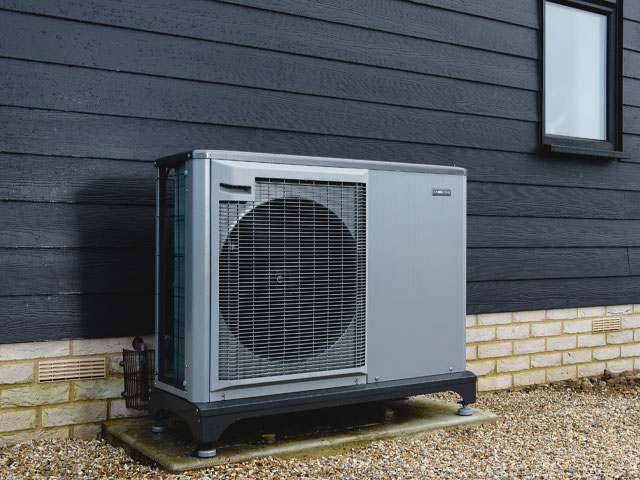
Nibe’s ASHP F2040, priced from £9,000, has a heat output of 8kW
Air source heat pump running cost comparison
When it comes to the air source heat pump running cost, it’s essential to consider the energy efficiency of your home. Estimates from Greenmatch suggest that for a typical four-bedroom house, annual running costs range from £685 to £1,550. However, homes with better insulation and airtightness can reduce the demand on the pump and lower the running cost.
John Taylor, managing director of Enhabit, advises improving your home’s thermal envelope to reduce heating demand and keep running costs in check.
Although air source heat pumps use electricity, their overall energy consumption is much lower than that of gas boilers. As a result, making them a greener option over time.
The Boiler Upgrade Scheme
You might think an air source heat pump pricey at £4,200 to £6,500. However, a ground-source heat pump is even more expensive, costing between £16,200 and £49,000 (plus, you need a lot of land for this option).
In a bid to reduce this expense, the government’s Boiler Upgrade Scheme makes £7,500 grants available to reduce the cost of low-carbon heating.
Manufacturers and the government are consulting on solutions to drive down the price of heat pumps and make them on a par with fossil fuel boilers by 2030.
Providing ministers succeed in reducing the price of electricity over the next decade. This is by shifting levies away from electricity bills, the air source heat pump running cost should be no higher either.
The government has pledged to achieve 600,000 installations every year by 2028, but there’s a long way to go. Industry figures show that, in 2025, 125,037 heat pumps were sold in the UK, a 27% increase from the previous year. This is compared to 1.7 million gas boilers.

Barn conversion by Pad Studio with Mitsubishi Ecodan air source heat pump. Photo: Nigel Rigden
Will you need new radiators for air source heat pumps?
When switching to an air source heat pump, you may need to upgrade your radiators. Since heat pumps operate at lower temperatures than traditional boilers, radiators will likely need to be larger to effectively heat your home.
‘We need to inform our customers that if they made the switch to renewables, they would need to have the correct heat loss calculations completed,’ says Chris Harvey, central heating and radiator expert at Stelrad.
‘This is because their radiators will likely need to increase in size. It is great to change the heat source, but radiators are the mechanism via which heat transfers into the room. This is a very important point that consumers will need to bear in mind.’
Stelrad already offers renewable system-compatible products like large K2 (double panel) and K3 (triple panel) radiators, as well as vertical models, all ideal for air source heat pumps.
Can air source heat pumps work with existing radiators?
In some cases, air source heat pumps can work with existing radiators. However, it depends on your home’s insulation and the size of your radiators.
Because heat pumps operate at lower temperatures, standard radiators may struggle to provide enough heat.
If your home is well-insulated or your current radiators are oversized, you might not need to replace them. However, if upgrades are necessary, installing larger or more efficient radiators, such as double or triple-panel models, will improve heat distribution.
A professional heat loss calculation can help determine whether your existing radiators are suitable or if additional radiators or larger units are needed to ensure efficient heating.

Heat pumps will require larger radiators. Photo: Yorkshire Radiators
Driving down air source heat pump costs
The hope is that rising demand, and subsequently an increase in supply, will bring down the air source heat pump installation cost. To help grow the market, a new £60 million Heat Pump Ready innovation programme was announced as part of the £1 billion Net Zero Innovation Portfolio.
The scheme provides funding to drive technological innovation. Therefore, resulting in heat pumps that are cheaper, smaller, and easier to install over the next decade.
‘The Heat and Buildings Strategy will help kick-start a cheap clean-heating revolution by bringing prices down for households and allowing companies to invest in scaling up their clean-heating operations,’ said Greg Jackson, CEO and founder of Octopus Energy.
‘Octopus has already committed £10 million investment to its research and development and training centre dedicated to the decarbonisation of heat, and has begun training engineers at the rate of 1,000 per year.
‘But this is just the beginning. By scaling up the technology and supply chain in Britain, innovative companies like ours will soon be able to fit and run heat pumps without any government support. As a result, bringing us one step closer to making the UK the Silicon Valley of Energy and creating thousands of clean energy jobs throughout the country.’

BakerBrown developed the plans for this gabled extension with 4kW photovoltaic solar panels powering a 3.5kW air source heat pump that feeds the underfloor heating
Demand for air source heat pumps is on the up
‘The heat pump industry is in the best shape it has ever been, with sales in 2021 already double those seen ever before,’ said Phil Hurley, Chair of the Heat Pump Association.
‘[The government’s] announcement was timed perfectly to take advantage of the Heat Pump Association’s training course.
The industry is now ready to retrain the UK’s army of installers with the capacity to train up to 40,000 per year, to ensure consumers can find a suitably trained and skilled heat pump installer when they need one.’
October 2026 budget impact on air source heat pumps
The October 2026 budget had big implications for the funding of air source heat pumps. We chatted to Scott Byrom, Home Energy Expert at The Energy Shop for his take on how this could have an impact on UK households.
“The signals coming out of government ahead of the October Budget were concerning for establishing a long term strategy for lowering household energy bills. This is as well as developing the UK’s domestic heat pump industry.
“Reports suggest the Treasury is planning to cut hundreds of millions of pounds from the Boiler Upgrade Scheme. This is the £2.7bn grant programme that offers up to £9,000 towards the cost of installing a heat pump, in order to help fund a shortfall in the defence budget.
“This decision represents clear risks. The Boiler Upgrade Scheme has been doing exactly what it was designed to do, and It has subsidised nearly 80,000 heat pump installations since 2022. Therefore, helping to drive down installation costs, and given manufacturers and installers the confidence to invest in training and supply chains.
“Households are already facing another expensive winter, and cutting this support means further reliance on volatile gas prices.
“Britain’s exposure to gas cost the Treasury £80 billion in the last energy crisis. The Boiler Upgrade Scheme budget is just a fraction of that, and it’s a key strategy to getting us off gas.
“What the industry needs more than anything right now is certainty. Manufacturers, installers and suppliers have invested, trained and planned on the strength of it. Cutting the plan back within a year would send the worst possible signal to the industry. If the scheme has to be reformed or eventually phased out, it needs to be a managed transition with clear notice, with alternative provisions made.”
Further heat pump cost implications
Air source heat pump retrofit tips from David Hilton, an authority in sustainable building and energy efficiency at Heat & Energy:
- ASHPs are not a universal replacement for boilers. They replace the primary heat source but there are things that need to be in place to avoid high electricity bills.
- Radiators for air source heat pumps must be compatible with the low flow temperatures of an ASHP. They need a greater surface area than standard radiators.
- Underfloor heating is particularly effective when used alongside a heat pump. Design the system with close pipe centres that are no further than 150mm apart. Good insulation under the pipes avoids conductive heat loss.
- Change an existing hot water cylinder for one that has a bigger, heat pump-compatible coil and a bigger storage capacity. A greater percentage of water from the taps is from the hot water cylinder mixed with a small amount of cold water.
- Ensure your installation meets the conditions that qualify for potential incentives or grants.
READ MORE: