
Thinking about heat pumps? Start here
Dalkin UK gives a clear breakdown on heat pumps for Grand Designs Magazine
By Jason Podesta |PROMOTIONAL FEATURE
When planning a new-build property or undertaking a renovation, heating decisions form a critical component of the wider design strategy. Modern homes increasingly adopt a whole-house comfort approach, integrating heating, cooling and hot water systems into a cohesive solution. Within this context, heat pumps are becoming a central consideration for homeowners seeking efficient and future-focused performance.
As headline sponsor of Grand Designs Live, Daikin UK provides practical, evidence-based guidance on how heat pumps operate within real homes and how they can be effectively incorporated into both renovation and new-build projects.
Will a heat pump work in my home?
A common question among homeowners is, “Will a heat pump work in my home?” In most cases, the answer is yes. Heat pumps can operate successfully in a broad range of property types, including period homes, modern renovations and newly constructed dwellings.
The suitability of a system depends less on the age of the property and more on how it is configured and used. Factors such as insulation levels, room layouts and heat distribution methods all influence performance. With appropriate planning and design, systems can be tailored to align with the specific requirements of the home and its occupants.
Will it keep my home warm enough in winter?
Concerns regarding winter performance are understandable. Contemporary heat pumps are engineered to deliver consistent, steady warmth even in colder conditions. Rather than producing short bursts of intense heat, they maintain an even indoor temperature, supporting a more balanced and comfortable living environment. Proper system design ensures effective heat distribution throughout the property.
Is a heat pump expensive to run?
Heat pump running costs vary depending on property size, system specification and energy tariffs. However, when correctly designed and installed, they can offer competitive and in many cases, lower operational costs compared with traditional gas boilers.
In a typical four-bedroom home, a Daikin heat pump can cost over £110 per year less to run than a gas boiler. Furthermore, dedicated electricity tariffs designed specifically for heat pumps can provide additional savings and greater predictability in day-to-day energy expenditure.
Do I need to change anything in my home?
Some properties may require adjustments during heat pump installation, while others may require minimal changes. Potential modifications can include radiator upgrades, the addition of a hot water cylinder, or targeted improvements to insulation and heating controls.
These adjustments are often incorporated into wider renovation schedules, reducing disruption. Early planning plays a crucial role in ensuring that the installation aligns seamlessly with other building works and that performance expectations are met.
Is now the right time to make the switch?
With financial support available through the Boiler Upgrade Scheme, many homeowners are considering heat pumps earlier in their project timelines. This government initiative provides funding towards the installation of low-carbon heating systems, helping to offset upfront investment costs.
Understanding eligibility criteria and application processes can assist homeowners in determining whether now represents the right time to transition from conventional systems.
Do heat pumps need underfloor heating?
Underfloor heating can complement heat pumps effectively, but it is not essential. Modern systems are compatible with appropriately sized radiators, provided the overall design accounts for flow temperatures, insulation standards and room usage patterns.
A well-considered design approach ensures that comfortable and even heating can be achieved without necessarily altering existing room configurations.
How big does a heat pump need to be?
Heat pumps are sized according to a property’s heat loss rather than the output of an existing boiler. This calculation considers insulation levels, glazing, layout and occupancy patterns.
Accurate sizing is fundamental. A correctly specified system operates steadily and efficiently, avoiding unnecessary cycling and enhancing long-term cost-effectiveness. When properly matched to the home, heat pumps can deliver reliable comfort throughout the year.
Are heat pumps noisy?
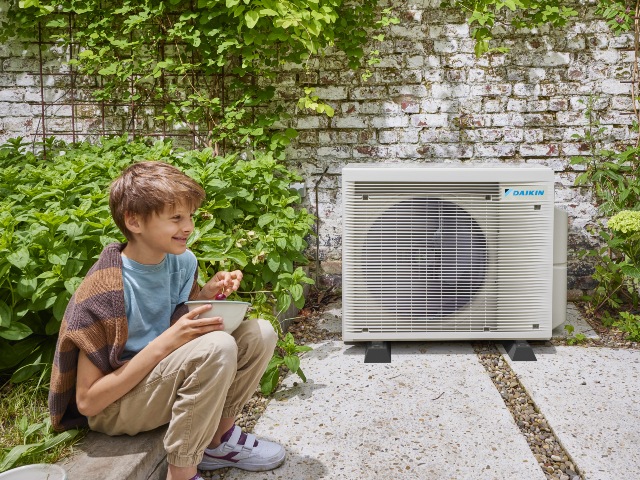
Modern heat pumps are designed with low-noise operation in mind. Outdoor units typically produce sound levels comparable to a quiet conversation, while indoor operation is subtle and unobtrusive. Correct positioning further minimises any perceptible impact, ensuring that performance does not come at the expense of tranquillity.

How long does it take to install a heat pump?
The duration of heat pump installation varies depending on the project scope. Some installations may be completed within a few days, while others form part of a broader renovation or new-build schedule. Factors such as electrical work, radiator adjustments and hot water cylinder integration influence overall timelines.
How long does a heat pump last?
When professionally installed and routinely maintained, heat pumps are designed for longevity. Systems from Daikin UK are engineered to operate reliably for 15 to 20 years or more. Long-term performance is supported by accurate system sizing, quality components and expert installation.
A considered approach to home heating
By integrating performance, efficiency and design, heat pumps represent a forward-looking solution for residential heating. With clarity around system design, heat pump running costs, heat pump installation requirements and available support such as the Boiler Upgrade Scheme, homeowners are better positioned to make informed decisions about modernising their heating strategy.
If you’re exploring heat pumps, Grand Designs Live offers clear answers to help you understand what will work best for your home. Visit us at Stand 60. Find out more >