The Venice Bienniale: everything you need to know the architecture international show
There’s still time to visit the Venice Biennale, which runs in the City of Love until the end of November. It’s full of fascinating displays and exhibits. Here’s everything you need to know…
Ironically enough, if you’re looking for inspiration for your next building project, the Architecture Biennale in Venice probably isn’t the right show to go to. For attainable inspo, and practical, try-it-tomorrow ideas, you’re better off heading to Grand Designs Live.
Architecture’s biggest international event
But if you’re interested in the built environment in a broader sense, and trends that will affect it in the future, then there’s heaps of interesting and inspiring stuff to see at architecture’s biggest international event.
And there’s still plenty of time to visit, because the show runs until November 23rd. Then again, if you’re someone who loves beautiful buildings, do you really need an excuse to visit Venice in the autumn?
This is the 19th Architecture Biennale. The event happens every two years (the clue’s in the name) in alternate years to the city’s international art show, which was the original Venice festival, started in 1895 as a way to attract more tourists to the city.
Architecture has had its own separate show since 1980, running each alternate year from May until November.
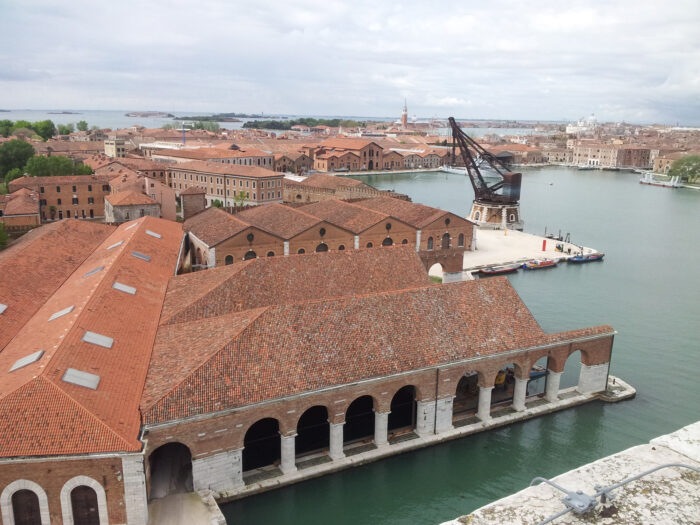
The Arsenale, venue for much of the Biennale. Image credit: Andrea Avezzù courtesy La Biennale di Venezia
The Biennale is spread across two main sites in the east of Venice: the Arsenale, Venice’s enormous ancient former naval dockyards (an extraordinary place in its own right, which would be worth a wander even if there were no show on): and the Biennale Giardini, a park containing permanent pavilions belonging to 26 nations including the UK, where temporary shows are staged.
Another 40 nations have put on exhibitions within the Arsenale or at other sites around Venice.

The Giardini where you will find the permanent national pavilions. Image credit: Andrea Avezzù courtesy of La Biennale di Venezia
National pavilions
The national exhibits are political in every sense and tell us a lot about how individual countries see themselves.
They range from (sometimes fairly bad but big budget) contemporary art installations with a theme related to the built environment, to more factual displays about some cutting-edge aspect of construction technology that the country concerned wants to show off about.
Some are more interesting than others, but they are all interesting for what they tell us about how nations want to be seen.
Focus on sustainability
Most pavilions this year deal directly or more obliquely with climate change.
Another common theme in several is the idea of care and repair – of buildings and the environment.
This reflects a growing recognition of the importance of maintaining and repurposing existing buildings – and reusing building materials – rather than always building something new.
This is another idea that is becoming increasingly significant within an architecture profession that wants to play its part in reducing greenhouse gas production and raw material use.
For context, it’s worth remembering that construction and the day-to-day use of buildings are a major cause of global-warming gases, accounting for as much as 40% of global carbon emissions.
Bahraini pavilion

The prize-winning Bahraini pavilion. Image credit: Andrea Avezzù
Noteworthy pavilions include Bahrain, winner of the Golden Lion award for the best national participation.
Their show explores how to cope with extreme heat using traditional cooling techniques (like wind towers, shading, etc) and modern passive cooling techniques.
British pavilion
The British pavilion was designed by Edwin Alfred Rickards in an 18th-century, Italianate-style, and built in 1909.
The exhibition inside this year has been co-curated in partnership with Kenya on the theme of the Geology of Britannic Repair.

The British pavilion is cloaked in a beaded curtain. Image credit: Marco Zorzanello
The pavilion has been covered in a ‘veil’ of beads made from agricultural waste briquettes and beads from Kenya and India.
This symbolises the connection between these regions and Britain through colonial history.
The shape of the veil is inspired by the traditional dwellings of the Kenyan Maasai people, while the glass beads reference those from Murano in Venice, which were historically used as currency to trade for metals, minerals, and people during the colonial era.
Shrouding the neoclassical pavilion is seen as an act of decolonialization.

The Earth Compass inside the British pavilion. Image credit: Marco Zorzanello
Inside there are various installations including the Earth Compass, which connects London and Nairobi through celestial maps of the night sky above both cities on 12th December 1963, the day of Kenya’s independence from British control.
On the surrounding walls is a cartography of the carbon emissions brought about by geologic empires, with the keloid “scars” creating an inverted index of cumulative national carbon emissions from 1750–2023.

The 3D-modelled shape of a slave trader’s cave. Image credit: Marco Zorzanello
In another room is an unsettling undulating woven rattan structure that is a reproduction of the interior of one of the Shimoni Slave Caves, a system of natural limestone caves in the Kenyan coastal town of Shimoni that served as holding cells for enslaved Africans before they were transported further afield.
Iceland

Icelandic exhibition focuses on lava. Image credit: Andrea Avezzù
The Icelandic pavilion presents a whacky but interesting idea about harnessing controlled volcanic eruptions in order to use molten lava as a sustainable building material to construct cities and infrastructure.
Finland

The Finnish pavilion was designed by celebrated architect Alvar Aalto. Image credit: Marco Zorzanello
The Finnish pavilion is about the architecture of stewardship and explores the often-invisible labour and knowledge that preserve architecture over time.
The exhibition traces the story of the Pavilion of Finland, which was designed by architect Alvar Aalto, from its construction in 1956, through three major restorations and decades of continuous maintenance, to today.
The Vatican

The pavilion of the Holy See is in a deconsecrated church. Image credit: Andrea Avezzù
The Vatican has its own pavilion in a disused church, exploring similar themes of care and restoration.
The Nordic countries

The radical and controversial Nordic countries pavilion. Image credit: Marco Zorzanello
The shared pavilion of Finland, Norway and Sweden explores architecture through the lens of the trans body, critiquing standard architectural forms and representation as a way to challenge modernist ideals and ask questions about whose bodies most architecture is really built for.
It has to be said, the national pavilions are a mixed bag. Some are more interesting than others, and there’s a lot of virtue signalling going on.
If you’re interested in learning about the kind of innovative ideas designers and engineers from all over the world are coming up with to deal with climate change, the main international exhibition in the Corderie, the old ropeworks of the Arsenale, is the place to go.
International exhibition

The Corderie at the Arsenale. Image credit: Giulio Squillacciotti courtesy La Biennale di Venezia
But be prepared: there are more than 300 exhibits in the beautiful 1000ft-long building, and the exhibition design is very unforgiving.
The displays are crammed in.
There’s no seating except the odd tiny 3D printed or hand-carved stool as part of an exhibit.
No intermediate ways in or out. No intermediate loos or café stops. No reentry. Once you begin, you’re in in. It’s a lot – and overwhelm is guaranteed.

Textures from construction traditions all over the world 3D printed using an earth-fibre mix. Image credit: Luca Capuano
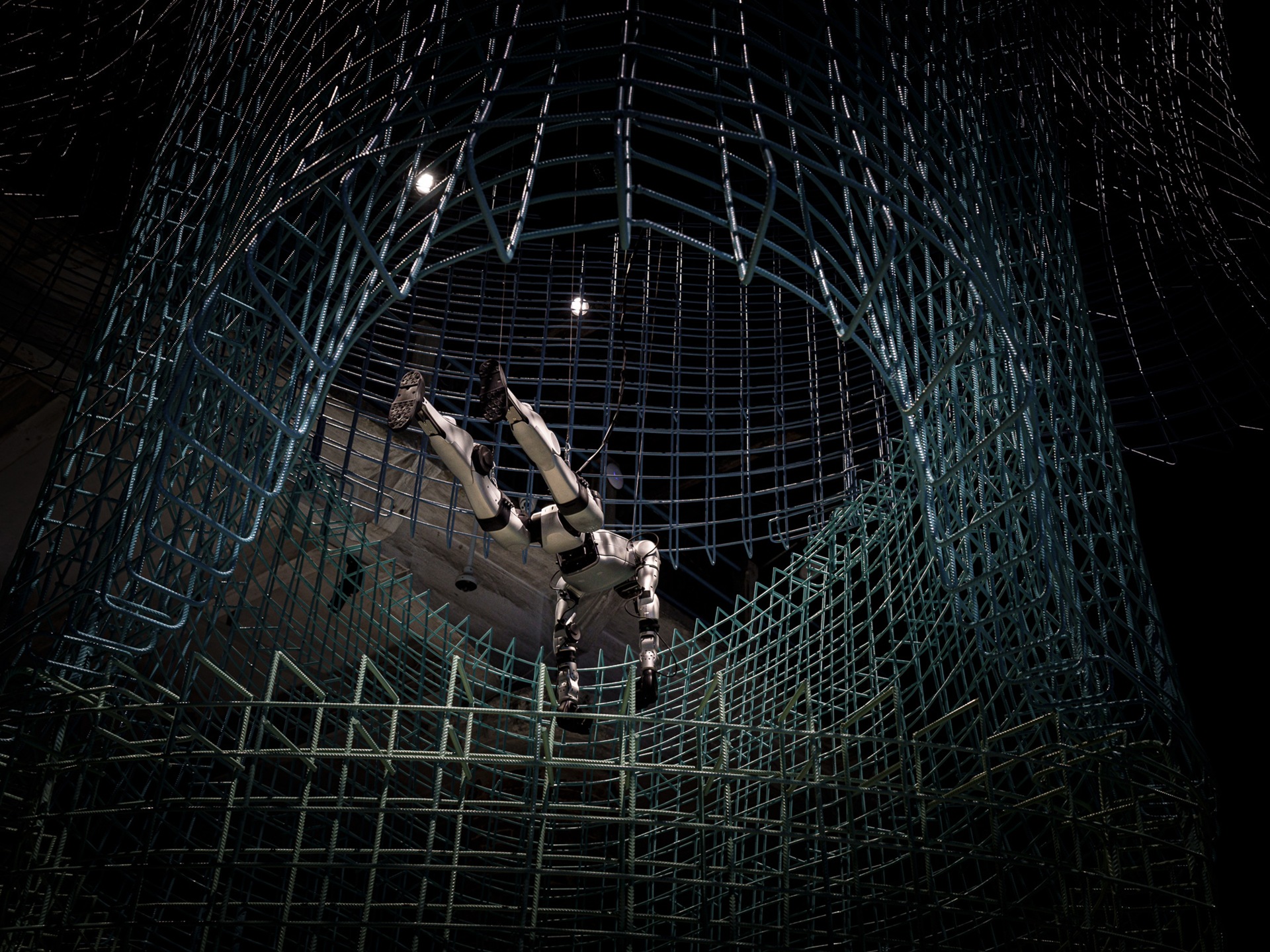
But there’s so much good stuff in here (including the robot at the top of this page) that, even if you only take in a quarter of it, you’ll still come away amazed and intrigued. And more hopeful about humanity’s ability to mitigate the effects of climate change.
Eclectic range of exhibits
The projects on display range from individual buildings that exemplify some new sustainable construction technique to ideas for how AI could be used to help with a whole range of things like mapping in the developing world; prototype tiles made from waste seashells to bricks made from elephant poo.
If you’re interested in the built environment in its broadest sense, and in how we tackle the challenge of climate change, then there’s so much to take in.

The Elephant Chapel by Boonserm Premthada is made of bricks made from elephant dung
The beauty of Venice

The exquisite Doge’s Palace Image credit: Pexels
Of course, the most important thing about the Biennale, if we’re really honest, is that it’s an excuse to visit Venice.
And, if you love beautiful buildings, that’s something not to be sneezed at. Despite the crowds of tourists, it remains a unique and extraordinary place – there’s a reason so many people visit.
City of canals

Atmospheric: a city build on water. Image credit: Pexels
Part of what makes this such a special place is of course the canals.
There’s just something so exciting about getting about on water instead of the road and watching the boatmen going about their business – from slick speedboat captains to builders on their workaday barges – is endlessly fascinating.
But so much of what makes Venice such an incredible place is the buildings: the Doge’s Palace, St Mark’s Basilica, the Campanile, the Scuola Grande di San Rocco, Ca’ Rezzonico, the clock tower on St Mark’s Square… not to mention the numerous other palazzos that line the canals.
Unique style
The architectural style is unique, a colourful mix of Byzantine, Gothic, Islamic, and Renaissance influences, reflecting Venice’s historic role as a maritime centre of trade.
It is a magical place with an aesthetic that is the complete opposite of minimalism: ornate decoration, multicolour marbles, mosaics, gold, delicate tracery.
Visual overload in the best possible way.
City at risk

A city at risk. Image credit: Pexels
It’s appropriate though that the Biennale should be focused on climate change because this incredible place is at risk thanks to a combination of climate change and subsidence.
Venice has seen a sharp rise in floods in recent years, with some of the worst floods ever occurring in the past 20 years. Some studies suggest low-lying parts of Venice could be permanently underwater by 2150, unless something significant is done.
MOSE, a new system of mobile flood barriers has been built to protects the city from high-tide flooding by temporarily isolating the Venetian Lagoon from the Adriatic.
But the salt marshes and lagoon ecosystems that have traditionally protected the city are under stress and the constant saltwater floods cause serious damage to historic buildings.
Perhaps, in the light of all that, you might feel you can’t justify the carbon footprint of taking a flight to Venice.
But if you feel you can, it is a sublime place to be in the autumn, and the 19th Venice Architecture Biennale is on until November 23rd.